Simplifying Identity Verification for India
Making complex KYC journeys easier to understand, navigate, and complete through clear, contextual content.
Company
PayPal
Project
India KYC for merchants and consumers
Focus
UX Content Strategy, Regulatory UX, Identity Verification
Delivering impact through simpler verification
$2.8M
Revenue preserved and generated
Combined revenue impact associated with the India KYC initiative.
100%
Ramp-up completed
Full completion of the planned India KYC ramp-up.
Results reflect the overall India KYC initiative, spanning consumer and merchant verification experiences.


Making compliance easier to navigate
To meet RBI regulatory requirements, PayPal needed to support identity verification for existing and new customers in India.
The challenge was to translate complex KYC requirements into intuitive digital experiences that helped customers understand what information they needed to provide, why it was required, and how to complete verification.
The work covered multiple customer journeys, including consumer KYC, merchant KYC, Aadhaar verification through DigiLocker, and video verification.
Regulatory complexity
Communicating mandatory verification requirements in language customers could understand.
Different customer needs
Supporting distinct verification journeys for consumers and merchants.
Multi-step verification
Helping customers navigate processes involving identity information, external verification services, and additional checks.
Turning regulatory requirements into clear customer guidance
The content approach focused on making verification requirements understandable and actionable while maintaining accuracy and compliance.
Clarity over complexity
Contextual guidance
Use straightforward, customer-friendly language to explain verification requirements without unnecessary regulatory jargon.
Help users understand what information or action is needed at each stage of verification.
Journey specific content
Adapt messaging to the needs of consumers and different merchant types rather than relying on one generic verification experience.
Consistent experience
Maintain clear terminology and a coherent communication approach across different KYC journeys and verification methods.
Designing clarity across the verification journey
The work covered multiple points in the KYC journey, each with its own information needs and decisions. The goal was to make complex requirements easier to navigate through clear content, contextual explanations, and purposeful actions.
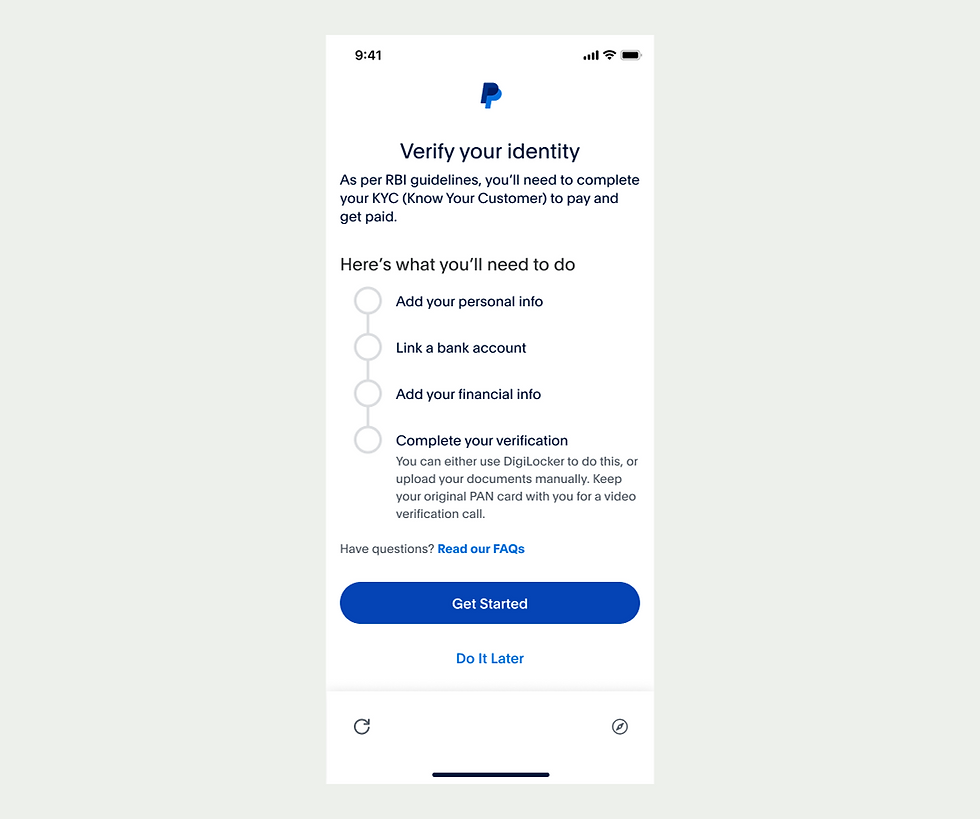
Helping customers navigate identity verification
Content designed to guide individual customers through required identity verification, including supported methods such as Aadhaar verification through DigiLocker and video verification.
Helping merchants identify the right verification path
Clear business-type selection content helps merchants identify the category relevant to their business before progressing through applicable verification requirements.

Making business verification easier to understand
Content for merchant verification journeys, where different business structures and verification requirements introduce additional complexity. The design focus is on clear instructions, terminology, and next-step guidance.

Understanding customer intent through simpler interactions
An intent-collection experience within the KYC journey, designed to make the questions and available choices understandable to customers.


Bringing clarity to complex compliance journeys
This project reinforced the importance of content design in regulatory experiences. When customers are asked to provide sensitive information or complete unfamiliar steps, clear language and contextual guidance become essential parts of the user experience.
Working across consumer and merchant verification journeys demonstrated the value of adapting content to different customer needs while maintaining consistency across a connected experience.
Complex regulatory requirements need clear, actionable customer communication.
Different customer journeys require contextual content rather than generic instructions.
Content design plays an important role in helping people understand sensitive verification processes.